
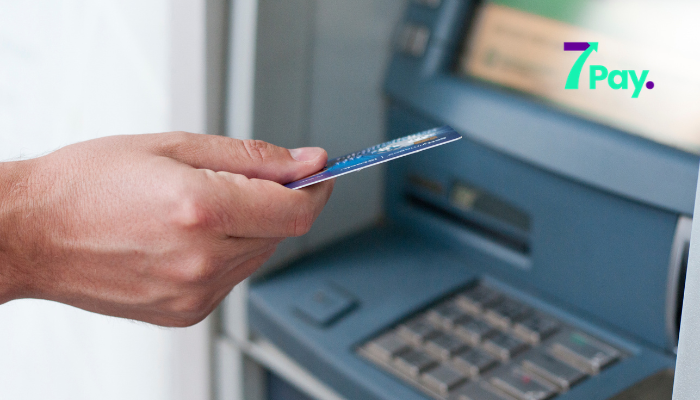
Knowing your ATM withdrawal limits in Pakistan can help you plan cash withdrawals, avoid declined transactions, and understand applicable charges. Limits can vary by card type, account, ATM, and financial institution, so there is no single figure that applies to everyone.
Whether you want to know the daily ATM withdrawal limit in Pakistan, understand your monthly ATM withdrawal limit in Pakistan, or compare limits across different card products, this guide explains the key factors in simple terms. It also covers ATM transaction limits, withdrawal charges, interbank transactions, and practical ways to manage your cash needs.
For users exploring convenient digital payment services, 7Pay can also be part of a broader approach to managing everyday digital transactions while reducing unnecessary reliance on physical cash.
What Is the ATM Withdrawal Limit in Pakistan?
The ATM withdrawal limit in Pakistan is the maximum amount of cash you can normally withdraw through an ATM within a specified period. Your actual limit depends on your card, account, institution, and applicable ATM rules.
An ATM cash withdrawal limit may be defined as a per-transaction, daily, or sometimes monthly restriction. These limits exist primarily for security, risk management, and cash-management purposes.
Your available balance is not necessarily the same as your cash withdrawal limit from ATM. For example, you may have sufficient money in your account but still be unable to withdraw the entire amount at once because your debit card limits are lower.
Daily ATM Withdrawal Limit in Pakistan
The daily ATM withdrawal limit in Pakistan determines how much cash can normally be withdrawn from your account during a single banking day or applicable 24-hour period.
The exact ATM withdrawal limit per day varies according to the card and account. Some cards may have relatively modest limits, while premium or specialized cards can provide substantially higher withdrawal capacity.
Before making a large withdrawal, check:
- Your debit card’s daily cash limit
- The ATM’s per-transaction restriction
- Your account’s available balance
- Applicable withdrawal charges
- Whether the transaction is on-us or interbank
- Any security restrictions on your card
If your requested amount exceeds the daily limit, the ATM may decline the transaction even when sufficient funds are available.
Monthly ATM Withdrawal Limit in Pakistan
A monthly ATM withdrawal limit in Pakistan is different from a daily limit. Not every card product necessarily uses a separate monthly cash ceiling, so users should check the terms applicable to their specific card.
The ATM withdrawal limit per month can also be affected by account controls, regulatory requirements, transaction monitoring, or internal risk policies.
If you regularly need substantial amounts of cash, do not assume that multiplying your daily limit by the number of days in a month represents your actual permitted monthly withdrawal. The applicable card and account terms should be treated as the controlling information.
Bank-Wise ATM Withdrawal Limits in Pakistan
Bank-wise ATM withdrawal limits in Pakistan can differ considerably because financial institutions offer multiple debit card categories and account products.
Instead of assuming that every customer has the same limit, check the official schedule for your particular card. A bank-specific ATM limit can depend on the card tier, account type, customer profile, ATM network, and transaction channel.
Searches such as HBL ATM withdrawal limit, Meezan Bank ATM withdrawal limit, UBL ATM withdrawal limit, MCB ATM withdrawal limit, or Allied Bank ATM withdrawal limit are useful when researching individual card products. The same principle applies to searches for Bank Alfalah ATM withdrawal limit, Faysal Bank ATM withdrawal limit, Askari Bank ATM withdrawal limit, and Standard Chartered Pakistan ATM withdrawal limit.
Customers may also search for Bank Al Habib ATM withdrawal limit, JS Bank ATM withdrawal limit, NBP ATM withdrawal limit, Soneri Bank ATM withdrawal limit, and HabibMetro ATM withdrawal limit.
However, a search result should not automatically be treated as the current limit. Card schedules and fee structures can be updated, so users should confirm the latest information through their financial institution’s official channels.
ATM Withdrawal Limit Per Transaction
The ATM transaction limit in Pakistan can operate at more than one level. Your card may have a daily limit, while the ATM itself may restrict how much cash can be dispensed in one transaction.
For example, even if your daily limit allows a larger withdrawal, the ATM may not dispense the entire amount in one operation.
The cash withdrawal per transaction can depend on:
- ATM cash availability
- Note denominations available in the machine
- Card and account settings
- ATM network restrictions
- Security controls
- Transaction processing rules
This is why a customer may sometimes need multiple additional ATM transactions to obtain the amount required, subject to the applicable daily limit and fees.
Debit Card Withdrawal Limit in Pakistan
The debit card withdrawal limit in Pakistan is normally linked to the card’s configured cash withdrawal allowance. It should not be confused with your total account balance or purchase spending limit.
A debit card can have separate limits for:
- ATM cash withdrawal
- Point-of-sale purchases
- Online purchases
- Contactless payments
- International transactions
Therefore, a bank card withdrawal limit is not necessarily identical to the card’s overall transaction capacity.
If you are planning a large debit card cash withdrawal, check the cash-specific limit rather than relying on the card’s purchase limit.
ATM Withdrawal Charges and Fees
ATM withdrawal charges can affect the total cost of accessing cash. The amount may depend on the transaction type, ATM network, account terms, and applicable fee schedule.
Non-Filer Withdraws are particularly relevant when using an ATM operated by a different financial institution. An interbank transaction may have different charges from a transaction performed through your own institution’s ATM network.
Before making repeated withdrawals, consider both the withdrawal amount and the applicable fee. Several small withdrawals can sometimes result in more fees than one permitted transaction.
Interbank ATM Withdrawal and 1LINK
Pakistan’s ATM infrastructure supports interbank transactions, allowing customers to access their accounts through participating ATM networks.
A 1LINK ATM withdrawal can involve an ATM belonging to a different institution from the one that issued your card. The availability of this service and applicable charges depend on the relevant network and card arrangements.
When making an interbank ATM withdrawal, users should check whether an additional fee applies and whether the ATM has sufficient cash.
If an ATM displays a fee notification, review it carefully before confirming the transaction.
Can You Withdraw More Than Your Daily ATM Limit?
Customers frequently ask, “Can I withdraw more than my daily ATM limit?” In normal circumstances, you cannot simply bypass a configured daily limit by entering a larger amount.
However, the available options can depend on your financial institution and card.
You may be able to:
- Request an ATM limit increase
- Change ATM withdrawal limit through an available banking channel
- Use another permitted withdrawal method
- Make withdrawals on different days
- Contact customer support for a temporary or permanent adjustment
Never attempt to bypass security controls or use someone else’s card to obtain additional cash.
How to Increase or Change an ATM Withdrawal Limit
If your existing limit does not meet your requirements, contact your financial institution and ask whether a higher limit is available for your card.
Depending on the institution, an ATM limit increase may be requested through a mobile application, internet banking, customer service, branch, or another authorized channel.
The institution may consider:
- Card type
- Account category
- Customer verification
- Transaction history
- Security requirements
- Internal risk controls
Not every card supports a higher limit. If you need a permanent change, ask specifically whether you can change ATM withdrawal limit settings for your card.
Factors That Affect ATM Withdrawal Limits
The ATM cash limit is not necessarily determined by one factor. Several elements can influence how much cash you can access.
Card Type
Different debit cards can have different withdrawal ceilings. Premium products may offer different limits from standard cards.
Account Type
The account associated with your card can affect applicable transaction restrictions and available services.
ATM Availability
An ATM cannot dispense money that it does not physically hold. Cash availability can therefore create a practical restriction even when your account limit is higher.
Network Rules
Transactions through different ATM networks may be subject to different processing arrangements, particularly for interbank withdrawals.
Security Controls
Temporary restrictions may be applied when unusual activity is detected or when additional verification is required.
Cash Withdrawal Rules
Always consider the current cash withdrawal rules associated with your card rather than relying on information published for another card category.
ATM Withdrawal Restrictions You Should Know
ATM withdrawal restrictions can occur for several reasons, including insufficient funds, exceeded limits, card status, incorrect PIN attempts, network issues, or ATM cash shortages.
A transaction can also fail when your requested amount exceeds the machine’s practical dispensing capacity.
If your transaction is declined, check your balance and available limit first. If the problem continues, contact the relevant card issuer rather than repeatedly entering transactions.
ATM Withdrawal Limits Comparison Table
The following comparison is designed to explain the different types of limits rather than publish potentially outdated institution-specific figures.
| Limit Type | What It Controls | What Users Should Check |
| Per-transaction limit | Maximum cash in one ATM transaction | ATM and card restrictions |
| Daily limit | Total permitted cash withdrawal during the applicable day | Debit card daily limit |
| Monthly limit | Aggregate monthly restriction where applicable | Account/card terms |
| ATM cash availability | Physical cash available in machine | ATM balance and denominations |
| Interbank withdrawal | Withdrawal through another network | Network and applicable fees |
| Security restriction | Temporary transaction controls | Card status and issuer instructions |
Bank-Wise Comparison: What to Verify
When creating a withdrawal limit by bank comparison, verify the card category and current official schedule before publishing a figure.
| Search Term | Information to Verify |
| HBL ATM withdrawal limit | Daily and per-transaction cash limit |
| Meezan Bank ATM withdrawal limit | Card-specific cash limit |
| UBL ATM withdrawal limit | Applicable debit card limit |
| MCB ATM withdrawal limit | Daily and transaction restrictions |
| Allied Bank ATM withdrawal limit | Card-level withdrawal allowance |
| Bank Alfalah ATM withdrawal limit | Card-specific cash limit |
| Faysal Bank ATM withdrawal limit | Daily ATM allowance |
| Askari Bank ATM withdrawal limit | Debit card cash limit |
| Standard Chartered Pakistan ATM withdrawal limit | Applicable card schedule |
| Bank Al Habib ATM withdrawal limit | Cash withdrawal allowance |
| JS Bank ATM withdrawal limit | Card-specific limits |
| NBP ATM withdrawal limit | Applicable ATM cash limit |
| Soneri Bank ATM withdrawal limit | Debit card restrictions |
| HabibMetro ATM withdrawal limit | Relevant card schedule |
This approach is safer than presenting a static number that may become outdated after a card-policy update.
How 7Pay Fits Into Everyday Digital Payments
7Pay focuses on making everyday digital transactions simpler by bringing convenient payment services into a modern digital environment.
While an ATM is designed primarily for cash withdrawal from debit card transactions, digital payment services can reduce the need to carry or withdraw cash for routine payments.
Depending on the services available through 7Pay, users can benefit from convenient options such as:
- Digital money transfers
- Bill payments
- Mobile recharge
- Everyday digital payments
- Convenient transaction management
- Secure payment experiences
Using digital payment methods for suitable purchases can make everyday transactions more convenient while keeping ATM cash withdrawals for situations where physical cash is actually required.
ATM Cash Withdrawal Safety Tips
Safe ATM use is just as important as understanding your withdrawal limit. A few simple habits can reduce unnecessary risk during cash transactions.
- Keep your PIN private.
- Never share your card credentials with another person.
- Check the ATM for unusual devices before inserting your card.
- Take your cash and card immediately after completing the transaction.
- Keep transaction receipts or digital records when appropriate.
- Report suspicious activity promptly.
- Avoid making unnecessary repeated withdrawals.
- Check your account activity regularly.
For digital transactions through services such as 7Pay, follow the same principle: protect your credentials and use only official channels.
What Is the Maximum ATM Withdrawal Limit in Pakistan?
There is no single maximum ATM withdrawal limit in Pakistan that applies universally to every customer and every card.
The maximum cash withdrawal can depend on the particular debit card, account, ATM, network, and applicable restrictions. Therefore, the most accurate answer to “how much can I withdraw from an ATM in Pakistan” is to check your card’s current official terms.
Likewise, the answer to “how much cash can I withdraw from ATM per day” depends on the daily limit configured for your specific card.
How Much Can I Withdraw From an ATM Per Month?
If your card does not have a separate monthly ceiling, your practical monthly capacity may be influenced primarily by its daily limit, available balance, transaction restrictions, and the number of days you can make withdrawals.
That does not mean a simple daily-limit calculation should be treated as an official monthly allowance.
For the question “how much can I withdraw from ATM per month,” always check whether your specific card has an aggregate monthly restriction.
ATM Withdrawal Limit and Charges: What to Check
Understanding the ATM withdrawal limit and charges in Pakistan together gives you a clearer picture of the actual cost and availability of cash.
Before withdrawing, check:
- Your daily cash withdrawal limit.
- The per-transaction restriction.
- Whether the ATM is within your card’s network.
- Applicable ATM withdrawal charges.
- Your available account balance.
- Whether additional transactions could create extra fees.
This simple checklist can prevent surprises when you need cash urgently.
Conclusion
Understanding the ATM withdrawal limits in Pakistan makes it easier to plan cash requirements and avoid declined transactions. Your ATM withdrawal limit per day, ATM withdrawal limit per month, and per-transaction allowance can all depend on your particular card and account.
Before making a large ATM cash withdrawal, check the current card schedule, available balance, ATM restrictions, and applicable fees. For interbank transactions, also consider the relevant network and charges.
For everyday payments that do not require physical cash, digital services can provide a convenient alternative. 7Pay is designed around convenient digital transactions, helping users manage everyday payment needs through a modern digital platform.
Call to Action
Explore 7Pay for convenient digital payment services, money transfers, bill payments, mobile recharge, and other everyday transactions designed for a simple and secure payment experience.