
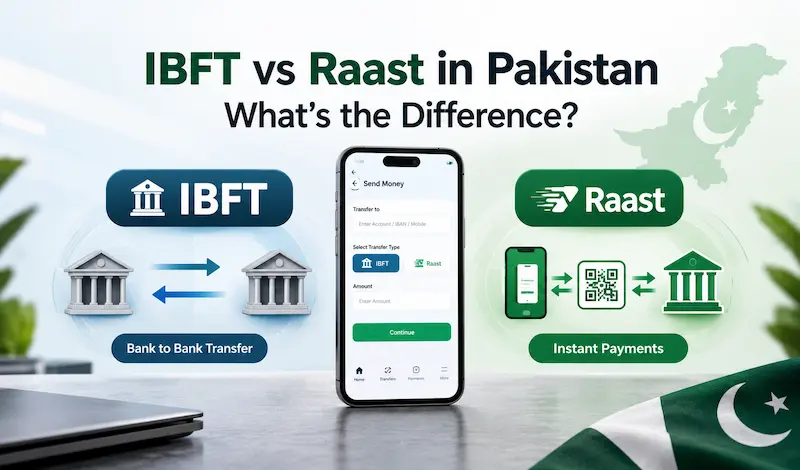
If you have ever sent money online and wondered whether to use IBFT or Raast, you are not alone. The debate around IBFT vs Raast in Pakistan comes up almost every time someone tries to move funds between two different banks. Both are legitimate ways to complete a bank-to-bank transfer, yet they work differently behind the scenes. In this guide, we break down plain language, compare their speed, fees, and limits, and show how a platform like 7Pay helps you manage both options from one simple dashboard at 7pay.com.pk.
What Is IBFT (Inter Bank Funds Transfer)?
IBFT, or Inter Bank Funds Transfer, is the traditional method banks in Pakistan use to move money from one account to another when the sender and receiver hold accounts at different banks.
IBFT has existed for years and remains one of the most widely used forms of bank transfer in Pakistan. It works through internet banking, mobile apps, and even ATMs, allowing customers to send funds using the recipient’s account number or IBAN. Because it relies on an older settlement structure, IBFT transactions sometimes take a little longer to reflect and often come with a nominal service charge, depending on the amount and channel used. Even so, IBFT transfer in Pakistan continues to be a trusted option, especially for people who are used to traditional online banking.
What Is Raast Payment System?
Raast is Pakistan’s instant payment system, introduced by the State Bank of Pakistan to make digital payments faster, cheaper, and more accessible for everyone.
Unlike older transfer methods, the Raast payment system was built specifically for real-time settlement. Instead of only using an account number, Raast lets users send and receive money through a Raast ID, usually linked to a mobile number. This makes person-to-person payments simpler and reduces the need to remember long account details. Raast transfer in Pakistan is generally free of cost for individual users, which is one of the biggest reasons it has grown so quickly since its rollout.
IBFT vs Raast in Pakistan: Core Differences
At a glance, the difference between IBFT and Raast comes down to how each system settles a transaction and what it costs the user.
IBFT works through a batch settlement process managed between banks, while Raast is built on a real-time payment system that clears instantly. This single structural difference explains most of what people notice when comparing IBFT vs Raast in Pakistan, from how quickly the funds appear to whether a fee applies. Understanding this distinction helps users pick the right method depending on urgency, cost, and the amount being transferred.
Comparison Table: IBFT vs Raast in Pakistan
Here is a simple side-by-side look at how the two options generally compare for everyday users.
| Feature | IBFT | Raast |
| Full Form | Inter Bank Funds Transfer | Pakistan’s Instant Payment System |
| Managed By | Banks via 1Link network | State Bank of Pakistan |
| Settlement Type | Batch-based | Real-time payments |
| Identifier Used | Bank account number / IBAN | Raast ID (mobile number) or IBAN |
| Typical Fee | Charges may apply | Usually free for individuals |
| Speed | Can take longer to reflect | Instant in most cases |
| Best For | Larger or scheduled transfers | Quick P2P payments |
This table is a useful starting point, but actual charges and processing times can vary slightly by bank, which is why comparing Raast vs IBFT Pakistan experiences with your own bank app is always a good idea.
Transfer Speed: IBFT or Raast?
Speed is often the deciding factor when people choose between the two, especially for urgent payments.
Since Raast is designed as a real-time payments network, funds usually land in the receiver’s account within seconds. IBFT, on the other hand, may need more processing time because it depends on bank-to-bank settlement cycles rather than instant clearing. If speed is your main concern, Raast transfer in Pakistan is generally the faster route, though IBFT transfer in Pakistan remains reliable for standard transactions that are not time sensitive.
Transfer Fees: Raast Payment vs IBFT
Cost is another area where these two systems clearly differ from one another.
Raast payment IBFT vs Raast in Pakistan charges usually favor Raast, since it was introduced partly to encourage low-cost digital payments and financial inclusion across Pakistan. IBFT transactions may include a small transfer fee depending on the bank, the channel used, and the transaction amount. For anyone sending money frequently, understanding these transaction fees ahead of time can help avoid unexpected deductions.
Transfer Limits Explained
Both IBFT and Raast come with daily and per-transaction limits, though these can vary from bank to bank.
Transfer limits are usually set according to account type, risk profile, and regulatory guidelines from the State Bank of Pakistan. Raast transaction limits have been eased over time to support wider adoption, while IBFT limits tend to follow more conventional banking thresholds. Before making a large transfer, it is worth checking your bank’s app or internet banking portal to confirm current limits for both options.
Security of IBFT and Raast Transfers
Both systems are built with strong safeguards, since they operate within Pakistan’s regulated banking and electronic funds transfer framework.
IBFT relies on established banking security protocols that have been refined over many years of interbank transfers. Raast, being a newer instant payment system, incorporates modern authentication layers designed specifically for real-time, mobile-first transactions. Whichever option you choose, using a secure money transfer method through your registered bank account or a trusted payment service provider like 7Pay adds another layer of protection to your online money transfer activity.
Which One Should You Use: IBFT or Raast?
The right choice between IBFT and Raast really depends on what you need at that moment.
If you want a quick, low-cost transfer between individuals, Raast is usually the better pick. If you are dealing with larger amounts, scheduled payments, or a bank that has not fully integrated Raast for a specific use case, IBFT is still a dependable fallback. Many users in Pakistan end up using both, switching between IBFT and Raast depending on the situation, which is exactly why understanding IBFT vs Raast in Pakistan matters for everyday digital banking decisions.
How 7Pay Makes Bank Transfers Easier
Managing multiple transfer methods does not have to be complicated, and this is where 7Pay adds real value.
At 7Pay, users can handle bank transfers, bill payments, mobile recharge, and other digital payment needs from a single, user-friendly platform. Rather than juggling different apps for different transfer types, 7Pay brings mobile banking convenience together in one place, with a strong focus on security and speed. Whether a transaction moves through IBFT or the Raast payment system on the backend, 7Pay is built to make the front-end experience simple for everyday users across Pakistan.
The Future of Digital Payments in Pakistan
Pakistan’s digital payment system is evolving quickly, and instant, low-cost transfers are becoming the new normal.
As more banks and platforms integrate real-time payments infrastructure, the gap in the IBFT vs Raast in Pakistan comparison may continue to narrow, especially on speed and cost. Even so, having a clear understanding of how each system works helps users make smarter choices today. Platforms like 7Pay are positioned to keep pace with this shift, giving users a reliable way to send and receive money as Pakistan’s digital payment methods continue to modernize.
Conclusion
Choosing between IBFT and Raast does not need to be complicated once you understand how each system works. The IBFT vs Raast in Pakistan comparison ultimately comes down to speed, cost, and the type of transaction you are making. Raast offers a faster, largely free option for everyday transfers, while IBFT remains a solid choice for larger or less time-sensitive payments. Whichever method fits your needs, having a reliable digital payment partner makes the whole process easier.
Call to Action
Ready to send money the smart way? Visit 7pay.com.pk today and experience fast, secure, and convenient digital payments, all in one place.
FAQs
1. What is the difference between IBFT and Raast?
IBFT is a bank-to-bank transfer that settles in batches, while Raast is an instant payment system built for real-time, mostly free transfers using a Raast ID or IBAN.
2. IBFT vs Raast, which is better?
It depends on your need. Raast is generally faster and free for smaller, everyday payments, while IBFT can be more suitable for larger or scheduled transfers.
3. How is Raast different from IBFT in terms of speed?
Raast settles almost instantly because it runs on a real-time payment system, while IBFT transfer in Pakistan may take longer due to batch settlement between banks.
4. Is Raast faster than IBFT?
In most cases, yes. Raast transfer in Pakistan is designed for instant clearing, whereas IBFT can involve a short processing delay depending on the bank.
5. Does Raast charge a fee?
Raast is generally free for individual person-to-person payments, while IBFT may include a service charge depending on the transfer amount and channel.
6. How does Raast work in Pakistan?
Raast lets users send and receive money using a Raast ID linked to their mobile number or their IBAN, making bank account transfers simpler than traditional methods.
7. How does IBFT work in Pakistan?
IBFT allows customers to transfer funds between different banks using the recipient’s bank account number or IBAN through internet banking, mobile banking, or ATMs.
8. Can I transfer money through Raast using 7Pay?
7Pay is built to support a smooth digital payment experience, helping users manage bank transfers, bill payments, and other services from one convenient platform.
9. What are the IBFT vs Raast transfer charges?
Raast is usually free for individuals, while IBFT charges can vary by bank and transaction size, so it is best to check current rates in your banking app.
10. What is the IBFT vs Raast transfer time difference?
Raast typically completes in seconds due to its real-time payments design, while IBFT transfer in Pakistan may take a bit longer because of batch-based settlement.